
AI Snippet Summary
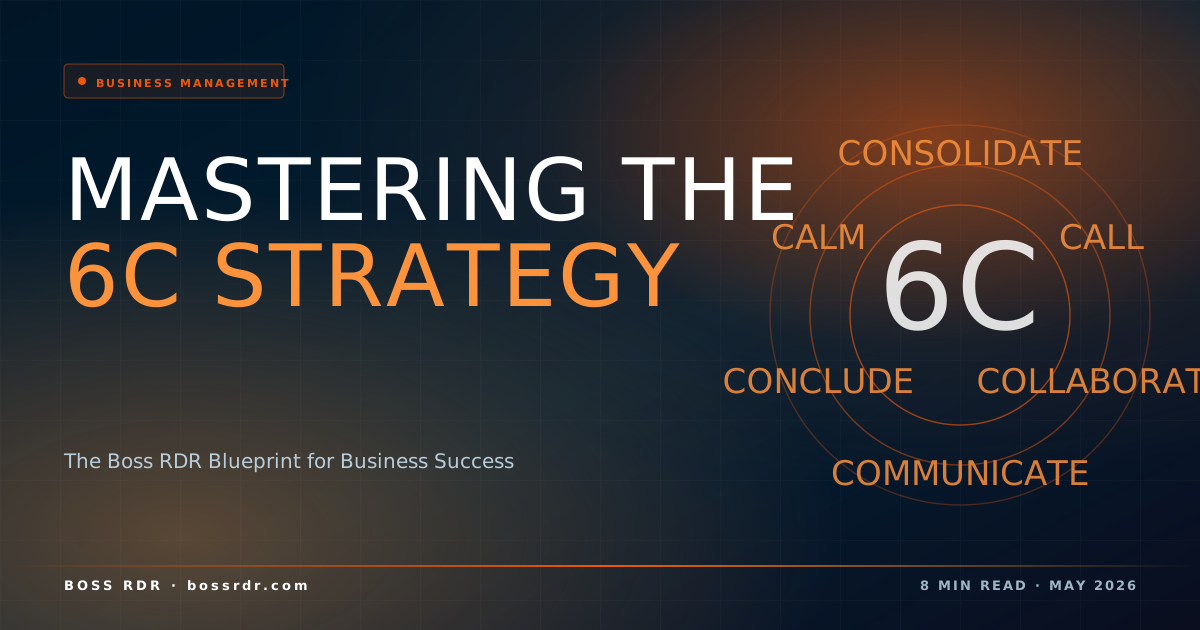
The 6C strategy for business management, popularized by Reymond "Boss RDR" delos Reyes, is a six-step framework for solving company problems with data instead of emotion: (1) Consolidate data and facts, (2) Call a meeting with the person involved, (3) Collaborate with superiors, (4) Communicate with respect, (5) Conclude with certainty, and (6) Calmness is power. Together, the 6Cs move owners from guesswork to evidence-based leadership.
Moving Beyond Presumption: The Power of Data-Driven Management
In the world of entrepreneurship, many owners struggle with the same recurring nightmare: employees who cause headaches and a business that seems to leak money for no clear reason. According to Reymond "Boss RDR" delos Reyes, the root of these failures rarely lies in the market — it lies in presumption. Owners are making major calls based on feelings, not facts.
To fix this, Boss RDR teaches the 6C Strategy: a rigorous, repeatable framework that brings discipline, data, and stability back to the way you run your company. It is built for Filipino SMEs that have outgrown the one-man-show stage and need a system that scales.
Why Assumptions Are Killing Your Business Growth
Too many business owners feel entitled simply because they own the company, yet they end up behaving more like gossips than executives. When revenue dips, they guess at the cause — blaming the store's aesthetics, the weather, or the marketing budget — without ever opening the numbers.
"Business equals numbers. If you are not tracking your data, you are simply lost." — Boss RDR
The 6C Strategy replaces palapalagay (assumption) with proof. Each step pushes owners toward observable, recordable facts — the only foundation strong enough to support a growing company.
The 6Cs of Solving Company Problems
Each C is executed in sequence. Skipping a step — especially the first one — is how owners end up firing the wrong person, moving to the wrong location, or scaling the wrong product.
1. Consolidate Data and Facts
Stop assuming. Start gathering. Before you accuse, restructure, or reinvest, document what is actually happening: opening and closing hours, foot traffic, conversion rates, top-selling SKUs, employee attendance, shrinkage logs, and customer behavior.
- Pull at least 30 days of sales and operational data.
- Cross-check what supervisors report with what the system records.
- Look for patterns, not single bad days.
Certainty is a byproduct of data. If you cannot point to numbers, you are not ready to act.
2. Call a Meeting With the Person Involved
When a problem points to a specific employee, confront them directly. Gossiping about a staff member with their peers is the fastest way to destroy a culture. It also gives the offender time to cover their tracks.
Direct confrontation — calm, factual, and private — signals to the team that you are watching and that consequences are real. As Boss RDR puts it, this prevents horns from growing: small bad habits hardening into permanent ones.
3. Collaborate With Your Leadership Team
Once you reach the macro stage, you cannot be in every aisle, register, and warehouse at once. Your supervisors and managers become your extra eyes. Their job is not to babysit — it is to deliver honest-to-goodness reports, recordings, and observations from the ground.
- Set a fixed reporting cadence (daily or weekly).
- Require evidence — photos, logs, or screenshots — not opinions.
- Reward leaders who surface bad news early.
4. Communicate With Respect
Authority does not give you the right to be disrespectful. Whether you are speaking to a senior manager or the security guard at the gate, the tone you set becomes the tone of the company.
"When respect disappears inside a company, discipline and professionalism follow it out the door."
Respect is not softness. It is the operating system that keeps your team accountable to you long after the meeting ends.
5. Conclude and Decide With Certainty
Only make major moves — firing a key hire, doubling the ad spend, relocating the store, or killing a product — when the data demands it. If you have a winning item that is already profitable, do not change it for the sake of innovation. Protect it, scale it, and study why it works.
Decisions made under emotional pressure are almost always reversed within 90 days. Decisions made with certainty compound.
6. Calmness Is Power
When chaos hits — a theft is uncovered, a key employee resigns, a viral complaint surfaces — the owner must be the calmest person in the room. The moment you rattle, your team loses confidence in the chain of command.
Calm is not passive. It is the discipline of returning to the data, naming the next action, and owning the outcome. It is the trait that separates operators from owners.
Managing the Back-End: Production, Finance, and Logistics
Many entrepreneurs obsess over the front-end — influencers, ad creatives, and storefront aesthetics. Boss RDR argues that the real leaks almost always hide in the back-end: production planning, finance, HR, and logistics.
- Front-end wins traffic. Back-end wins margin.
- A beautiful brand cannot outrun broken inventory.
- Cash is decided by reconciliation, not by revenue.
Audit your back-end with the same intensity you give your marketing calendar. That is where the 6C Strategy compounds fastest.
Treating Your Business Like a Family: The Parent-Child Analogy
A business, Boss RDR likes to say, is like a baby. It will not know how to walk, talk, or feed itself unless you — the parent — are hands-on enough to teach it and patient enough to build the systems around it.
Systems are how a business eventually grows up. Without them, the company stays dependent on the owner forever. With them, it learns to run, defend itself, and one day support the family that built it.
Conclusion: Turning Uncertainty Into Profit
At the end of the day, your business is the engine that supports your family. The difference between an owner who is exhausted and one who is in control is not luck — it is method.
By moving from emotion-based palapalagay to the data-driven 6C Strategy, you build a company that is profitable, professional, and sustainable. You stop reacting. You start leading.
Consolidate. Call. Collaborate. Communicate. Conclude. Stay calm. — The 6Cs of Boss RDR