
RDR Talks · EpisodeVince Martinez Interview25 branches, P70M earnings — the full conversation.
RDR Vlog · Field TourBig Brew Warehouse TourInside the 2,500 sqm logistics hub powering 1,600+ branches.
In the noisy, hyper-competitive world of Philippine milk tea, most brands fight over the same mall-going, P150-a-cup customer. Big Brew did the opposite. It planted its flag in the wet markets, terminals, and busy intersections of Bulacan and Pasay, priced its drinks at P29 and P39, and quietly built a network of more than 1,600 branches nationwide.
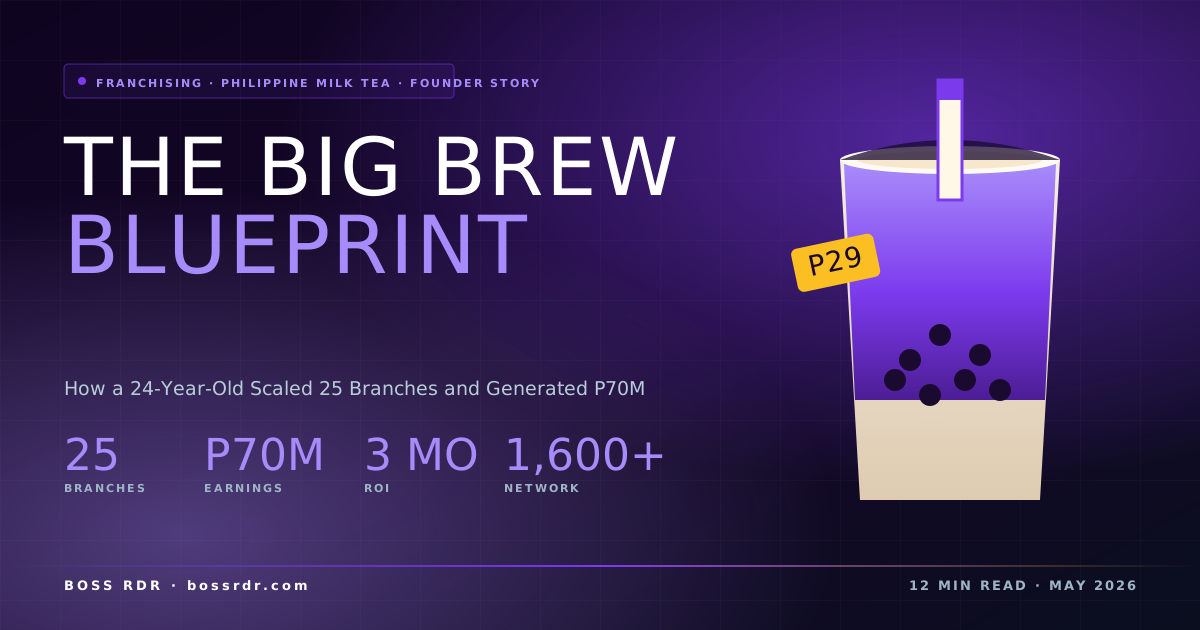
Inside that network, one name keeps coming up: Vince Neil Martinez. At just 24, Vince has scaled from a single Big Brew outlet to 25 branches in under three years, with total earnings hovering around P70 million. He is, by any honest measure, one of the loudest success stories in Philippine franchising today.
This article unpacks how he did it — drawn from his on-the-record interview with Reymond "Boss RDR" delos Reyes on the RDR Talks and RDR Vlog series, a physical tour of the brand's 2,500-square-meter warehouse, and the operating playbook other franchisees can actually copy. If you have ever asked whether a low-cost franchise in the Philippines can truly make you a millionaire, this is the receipt.
The P29 Phenomenon: Why Big Brew Became the "Milktea ng Masang Pilipino"
For a decade, milk tea in the Philippines was treated like a luxury. A single cup of pearl milk tea at a mall kiosk could cost more than a full meal, putting it firmly out of reach for the average jeepney commuter, factory worker, or college student on a P200 daily budget. Big Brew looked at that landscape and saw a problem to solve, not a price tier to defend.
By engineering a supply chain that could deliver real milk tea at P29 and a premium line at P39, the brand collapsed the cultural barrier between "treat yourself" and "everyday drink." The result is a category of customer the high-end brands never bothered to serve — and a daily transaction volume that quietly dwarfs the boutique players.
Disrupting the High-End Market with Quality and Affordability
The most common objection to a P29 milk tea is the obvious one: it must taste like P29. Vince Martinez and Boss RDR address this head-on during the interview. Side-by-side tastings against brands that retail at P120 to P180 consistently leave customers surprised. The flavor profile is close, the texture of the pearls is comparable, and the cup size is honest.
That quality-to-price ratio is the engine of Big Brew's word-of-mouth growth. In a market where Filipinos are famously vocal on Facebook and TikTok about value-for-money finds, a credible P29 milk tea becomes a story customers tell for free. Big Brew did not have to outspend the premium players on marketing. It only had to make the math obvious.
The "Masa" Formula: Volume Over Margin
Margin per cup at Big Brew is intentionally smaller than what premium brands enjoy. Vince estimates the franchisee earns roughly P10 to P15 of contribution per cup after cost of goods. On paper, that looks unattractive next to a P60 mall margin. In reality, it is the entire competitive moat.
Because the drink is priced for daily consumption, a single branch can move 200 to 300 cups a day on a normal weekday — and spike well beyond that during paydays, fiestas, school dismissal hours, and the legendary "petsa de peligro" pre-payday squeeze. Multiply small margin by big volume and you get a cash-flow engine. Multiply that engine by 25 branches and you understand how a 24-year-old reaches P70 million.
"Cheap is not the same as low quality. Cheap, done with discipline, is a business model."
Vince Martinez: From Academic Failure to Multimillionaire at 24
To understand the Big Brew blueprint, you have to understand the operator behind those 25 branches. Vince Martinez is not a legacy heir or a finance graduate from a top university. His origin story is much closer to that of the customer Big Brew serves.
Overcoming the "Booksmart" Stigma
Vince grew up as the kind of student parents brag about. Honors, scholarship considerations, the works. Then the pandemic happened, his class shifted online, and a technical issue caused him to fail a college subject. For a young man whose identity was tied to academic performance, the setback was heavier than the grade itself.
Watching his peers move forward without him, Vince made a quiet decision: if school was no longer the fastest path, business would be. He cycled through a parade of small ventures — selling churros at events, painting houses, taking on odd jobs — collecting the kind of street-level lessons no business school assigns. Most of those experiments failed. They were also the unglamorous tuition that made him useful behind a Big Brew counter.
The First Branch: Finding the "Winning" Location in Bulacan
The turning point came on his birthday. Vince tried Big Brew for the first time in Pasay, did the mental math on the price and the line, and saw the opportunity that everyone else had been walking past. He decided to bring the brand home to Bulacan.
Then came the part most aspiring franchisees never talk about: six location rejections in a row. Property owners did not believe a P29 milk tea could pay the rent. Vince kept walking the streets of Malolos, Pulilan, and Baliwag until he found a high-foot-traffic intersection in Baliwag that finally said yes. That single branch — the one that almost did not happen — became the spark that lit the 25-branch fire.
"If you stop at the sixth no, you never get to hear the seventh yes."
The 50/50 Marriage: The Secret to Franchise Longevity
Ask Vince why so many franchisees fail and he does not blame the brand, the location, or the economy. He blames the relationship. A franchise, in his words, is a marriage. Both sides have to show up, and neither side can outsource its half of the work.
The Franchisor's Responsibility: Systems and Support
Big Brew's half of the 50/50 is the system. That includes the recipe and ingredient supply, the brand book and store design, the marketing engine that keeps the brand top-of-mind, and the operational backbone that makes sure no branch runs out of stock during a Saturday rush. A franchisee never sees most of that work. They only feel it when it is missing — and at Big Brew, by Vince's telling, it is rarely missing.
The Franchisee's Responsibility: Execution and Passion
The other half belongs to the entrepreneur. Showing up before opening. Greeting regulars. Coaching the staff who actually pour the drinks. Watching the cash, the wastage, and the cleanliness obsessively. Vince is candid that the franchisees who treat their store like a "hobby" — visiting once a week, leaving the books to a relative — almost always struggle, no matter how strong the brand.
"You don't get rich just by buying a franchise. You get rich by being a great entrepreneur inside that franchise." — Boss RDR
That single line, delivered by Boss RDR during the interview, may be the most important sentence in this entire article. The brand is the vehicle. The owner is still the driver.
Inside the Engine: Logistics, Warehousing, and Scaling to 1,600+ Branches
Most franchise stories stop at the success of one location. What makes Big Brew unusual is what happens behind the scenes — and what Boss RDR walked through, on camera, during the warehouse tour.
The 2,500 SQM Powerhouse
Big Brew operates a 2,500-square-meter warehouse that serves as the nervous system for its 1,600-plus branches. Inside, ingredients are pre-portioned, packed, and staged for dispatch. When a branch places a restock order, the standard fulfillment window is roughly 20 minutes from picking to dispatch — a number that would embarrass plenty of larger food and beverage chains.
That logistics muscle is the unglamorous reason a P29 cup actually works. Cheap retail prices only survive if the supply chain behind them is brutally efficient. Big Brew has invested where customers never look so that customers can keep enjoying the price they do look at.
Client Managers: Supporting the Entrepreneur's Journey
The other quiet advantage is the Client Manager (CM) system. Every Big Brew franchisee is assigned a dedicated CM whose job is to be on the phone, on the ground, and in the group chat when operational problems hit. A broken machine on a Saturday night, a sudden staff resignation, an unexpected health inspection — these are the moments where franchisees in lesser systems get ghosted. Big Brew's CMs are designed to pick up.
That sounds like a soft benefit. It is actually the difference between a franchisee surviving year one and quietly closing the doors.
The Financial Reality: ROI, Profit Margins, and Daily Operations
Now to the part every aspiring franchisee actually clicked for: the money.
Recovering Your Investment in 3 Months
Vince's personal experience puts ROI for a well-located Big Brew branch at roughly three months. Some of his locations recovered capital in as little as one month, an outlier number that he attributes to a near-perfect mix of foot traffic, opening-week marketing, and an owner who was physically present from day one.
Even using the more conservative three-month figure, the math is unusual by Philippine franchise standards. Compared to fast-food investments that can take 18 to 36 months to break even, a milk tea kiosk that pays itself back in a quarter is functionally a different asset class.
Managing High Volume: 300 Cups a Day
A high-performing branch in Vince's portfolio routinely posts 300 cups a day. At a blended ticket of roughly P30 to P39, that translates to monthly sales in the P500,000 to P1,000,000 range per branch. With franchisee margins reported at 40 to 45 percent gross, the operating cash flow per branch becomes obvious — and explains how 25 branches stack into a P70 million career number.
None of those numbers are guarantees. They are receipts from one operator, in one network, in one stretch of years. But they exist, they are on the record, and they reset what a young Filipino entrepreneur is allowed to believe is possible.
What Other Filipino Entrepreneurs Can Take From the Big Brew Story
Strip away the warehouse footage and the P70 million headline and Vince's playbook reduces to a short list of habits any aspiring franchisee can actually copy:
- Pick a price point your real neighborhood can afford every day, not once a month.
- Choose a franchisor whose logistics you can physically visit and verify.
- Walk locations until the seventh "yes," not just the sixth "no."
- Treat your first branch like a job, not a side hustle, for at least the first year.
- Reinvest cash flow into branch two before you reward yourself with lifestyle upgrades.
- Build a relationship with your Client Manager — they are your fastest path out of an operational crisis.
The deeper lesson, though, is cultural. Big Brew is winning because it took the Filipino masa seriously as a customer. Vince is winning because he took himself seriously as an operator before the market took him seriously as a millionaire. Those two decisions, in that order, are the actual blueprint.
Execution beats education. Stop researching and start doing the work.
How to Get Started With a Big Brew Franchise
For readers actively shopping for a franchise investment, the practical next steps are straightforward. Big Brew accepts franchise inquiries primarily through its official Facebook presence (search "Big Brew" or "Big Brew Franchise"), where the team routes serious applicants to the franchise department for site evaluation, costing, and contract review.
Before that conversation, do three things. First, visit at least two existing branches at different times of day and count the cups yourself. Second, talk to a current franchisee — Vince's public profile, and the RDR interview itself, makes this unusually easy. Third, be honest about whether you are buying a business or buying a story. Big Brew rewards the first kind of buyer.
The Bottom Line
Vince Neil Martinez's 25-branch run is not a lottery ticket. It is the predictable output of a brand that built logistics before it built hype, a franchisee who showed up every day, and a country full of customers who had been quietly waiting for someone to take their P29 seriously.
Big Brew did not just sell a cheaper milk tea. It sold a permission slip to a generation of young Filipino entrepreneurs who were told they needed a diploma, a rich family, or a Makati address before they were allowed to dream in eight figures. The receipts are now on camera. The blueprint is now on paper. The next move is yours.